


Which Dental Restoration Is Best for Your Smile Makeover?

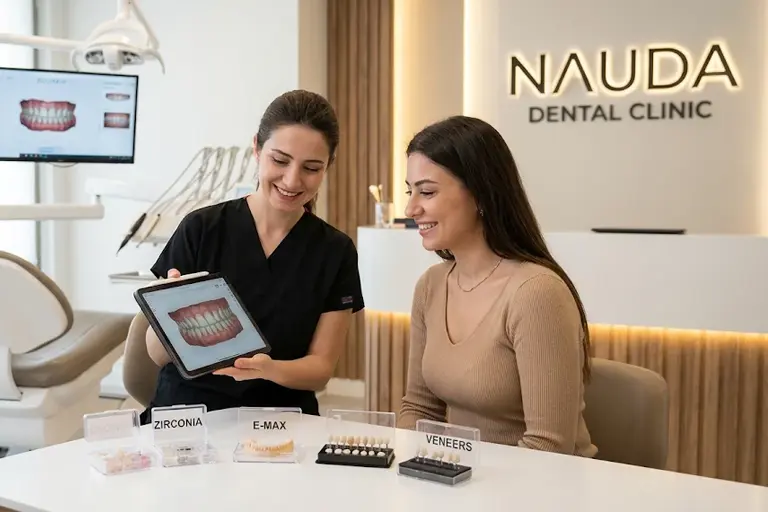
Which Dental Restoration Is Best for Your Smile Makeover? (2026)
Meta description: Compare zirconia, E-max, and porcelain veneers for cracked, worn, or stained teeth. Discover which restoration suits your smile makeover.
Cracked, worn, or stained teeth may affect your smile. Choosing the right restoration directly influences both the appearance and durability of your treatment. Materials such as porcelain, zirconia, and E-max meet different needs. Nauda Dental Clinic in Istanbul makes this process easier to understand by offering restoration plans tailored to each patient’s facial features and smile line.
In this article, you will learn about crown and veneer materials, which options suit different dental problems, and what to consider during treatment.
- 1 Key Takeaways
- 2 What Is a Dental Crown, and When Is It Needed?
- 3 Zirconia Crowns
- 4 E-max Crowns
- 5 Porcelain Laminate Veneers
- 6 Choosing a Restoration for Different Dental Problems
- 7 Restoration Materials Compared
- 8 The Smile Makeover Process
- 9 Aftercare and Longevity
- 10 Conclusion: How to Choose the Right Dental Restoration
- 11 Frequently Asked Questions
Key Takeaways
- Zirconia crowns are frequently chosen for front and back teeth because of their high fracture resistance and natural appearance.
- E-max restorations offer exceptional translucency, creating an appearance closely resembling natural enamel on front teeth.
- For cracked or broken teeth, a full-coverage crown surrounds the entire tooth and is one of the most reliable ways to provide structural support.
- Nauda Dental Clinic creates individual smile makeover plans tailored to each patient’s facial features and personality.
- The right material depends on the tooth’s location, the type of damage, your aesthetic expectations, and your everyday chewing habits.
What Is a Dental Crown, and When Is It Needed?
A dental crown is a protective restoration placed over a damaged, weakened, or misshapen tooth. It covers the entire tooth to restore its function and appearance.
Crowns may be recommended for cracked or broken teeth, severe wear, root-canal-treated teeth, weakened teeth with large fillings, and restorations placed on dental implants.
The American Association of Endodontists emphasizes the importance of early intervention for cracked teeth to help prevent tooth loss. Crown planning can therefore be an integral part of treatment.
Zirconia Crowns
A Balance of Strength and Aesthetics
Zirconia crowns are made from zirconium dioxide, a high-strength ceramic material. They are metal-free and biocompatible, avoiding the dark gumline associated with metal frameworks.
Zirconia has a fracture resistance of approximately 1,200 MPa. This is almost twice that of some other all-ceramic materials. It can be used for both front and back teeth.
At Nauda Dental Clinic, custom zirconia crowns are prepared using digital impressions and shade-matching technology. A raw-staining technique helps achieve durable aesthetics with shades close to those of natural teeth.
E-max Crowns
Natural-Looking Results for Front Teeth
E-max restorations are made from lithium disilicate glass-ceramic and offer very high translucency. They closely resemble the transparency of natural enamel.
E-max is preferred for front teeth, particularly in areas visible when you smile. Its fracture resistance is approximately 400–500 MPa, making it suitable for single crowns and thin veneers.
However, zirconia may be more suitable in back-tooth areas exposed to heavy chewing forces. When planning a smile makeover, Nauda Dental Clinic combines E-max and zirconia according to tooth location to balance appearance and durability.
Porcelain Laminate Veneers
Minimal Intervention, Maximum Aesthetics
Laminate veneers are thin porcelain shells bonded to the front surfaces of teeth. They require the removal of only a small amount of tooth structure and are therefore a more conservative approach than full crowns.
Veneers are particularly suitable for discoloration, mild misalignment, small chips, and gaps between teeth. For severely damaged or root-canal-treated teeth, a full-coverage crown offers a more reliable solution.
The American Dental Association (ADA) notes that veneer treatment is irreversible, so the decision should always be made together with a dentist.
Choosing a Restoration for Different Dental Problems
Cracked or Broken Teeth
A cracked tooth may cause pain because its sections move during chewing. A full-coverage crown surrounds the tooth and helps prevent the crack from progressing. Zirconia offers strong protection thanks to its high fracture resistance.
Worn Teeth
Teeth grinding, or bruxism, and acidic dietary habits can cause substantial tooth wear. Crowns restore tooth height and improve bite balance. Zirconia crowns are frequently chosen for these cases.
Stained or Discolored Teeth
Surface stains can be treated with professional teeth whitening. However, internal discoloration, including tetracycline staining, fluorosis, and discoloration in non-vital teeth, may not respond to whitening. In these cases, porcelain veneers or E-max crowns can mask the underlying color for an aesthetic result.
Implant-Supported Restorations
Crowns are attached to implants used to replace missing teeth. Nauda Dental Clinic uses titanium-bar-supported monolithic zirconia crowns. The screw-retained design makes cleaning and repairs easier, while the monolithic structure reduces the risk of chipping.
Restoration Materials Compared
| Feature | Zirconia Crown | E-max Crown | Porcelain Laminate Veneer |
| Strength | Very high (approximately 1,200 MPa) | Moderate to high (approximately 400–500 MPa) | Moderate |
| Translucency | Good | Very high | High |
| Suitability for front teeth | Suitable | Very suitable | Very suitable |
| Suitability for back teeth | Very suitable | Limited to single crowns | Not applicable |
| Metal content | None | None | None |
| Tooth structure removed | Moderate | Moderate | Minimal |
The Smile Makeover Process
A smile makeover is not a single procedure but a coordinated treatment plan with several stages. It begins with a clinical examination and digital scanning. The condition of your teeth, gum health, and bite balance are assessed.
During digital smile design, the proposed result is previewed using the patient’s own photographs. After the patient approves the shade and shape, the teeth are prepared and temporary restorations are placed.
Custom crowns or veneers are then made in the laboratory. Nauda Dental Clinic uses digital impressions and biocompatible materials throughout the process. In the final stage, the permanent restorations are checked and secured to the teeth.
Aftercare and Longevity
With proper care, dental restorations can last for many years. Zirconia crowns may last an average of 10–15 years with regular maintenance, while porcelain veneers may last approximately 10 years. Individual results vary depending on oral hygiene habits.
To extend the life of your restorations, brush twice daily and floss every day. Avoid biting directly into hard items such as ice and hard-shelled nuts. If you grind your teeth, make sure you use a night guard, also called a bruxism splint.
Regular dental checkups are important for assessing your restorations and identifying potential problems early.
Conclusion: How to Choose the Right Dental Restoration
There is no single “best” material for a smile makeover. The right choice depends on the tooth’s location, the type of damage, your aesthetic expectations, and your chewing habits. Zirconia stands out where strength is important, while E-max offers a natural appearance for front teeth. Porcelain veneers are preferred for cosmetic improvements requiring minimal intervention.
Nauda Dental Clinic in Istanbul creates personalized smile makeover plans to identify the most appropriate restoration for your teeth. A clinical examination and digital planning are the best starting points for treatment.
Frequently Asked Questions
Which is better: a zirconia crown or an E-max crown?
Zirconia crowns offer higher fracture resistance and can be used on both front and back teeth. E-max crowns offer exceptional translucency for a more natural appearance on front teeth. The location and needs of your tooth determine which option is suitable.
What is the difference between a porcelain veneer and a crown?
A porcelain veneer covers only the front surface of the tooth and requires minimal tooth reduction. A crown covers the entire tooth and reinforces structurally weakened teeth. Nauda Dental Clinic recommends the most suitable option based on the condition of the patient’s teeth.
Is getting a dental crown painful?
Crown treatment is performed under local anesthesia, so you should not feel pain during the procedure. Mild sensitivity may occur afterward, but it usually resolves within a few days. Nauda Dental Clinic offers additional support for patients experiencing dental anxiety.
How should I care for my teeth after getting crowns or veneers?
Brushing twice daily, flossing every day, and attending regular dental checkups help extend the life of your restorations. Avoid biting directly into hard foods, and use a night guard if you grind your teeth.
How many appointments does a smile makeover take?
Treatment time varies according to the patient’s needs. It generally includes a clinical examination, digital planning, tooth preparation, and placement of permanent restorations. Nauda Dental Clinic organizes the treatment plan around the patient’s schedule and explains each stage in advance.